Find all editions of Cough Science News below and get access to the latest cough science developments, publications, and interviews with cough experts.
8 March 2026
Hello!
One of the recurring themes in my conversations this month, at conferences, with collaborators, with pharma teams, is that the cough field is moving faster than most people outside it realize. The science is deepening, the measurement tools are maturing, and the financial case for adopting them is now backed by real numbers.
There's a lot to cover this month: reflections from the Barcelona International Cough Conference, new research, and an opportunity to collaborate with us on a bronchiectasis study.
We're looking for collaborators: NCFBE natural history study
Hyfe is looking for academic collaborators to co-develop a natural history study of cough in non-cystic fibrosis bronchiectasis (NCFBE). We have a specific funding pathway in mind and a short timeline to move on it.
If you're working in bronchiectasis and interested in leading or partnering on a study that uses continuous cough monitoring to characterize disease burden and progression, I'd love to talk. Reach out to me directly at peter@hyfe.com.
Our team was at the Barcelona International Cough Conference last month. What follows is less a conference report and more a summary of what I took away from it - the themes that matter most to where this field is heading.
Cough hypersensitivity is no longer a fringe concept. Prof. Lorcan McGarvey traced the science back to the 1970s. Our understanding of neuroscience, brain imaging, and peripheral nerve biology have matured dramatically since then. The mechanisms are increasingly well understood. What's still lagging is clinical recognition, and that's a problem we can do something about.
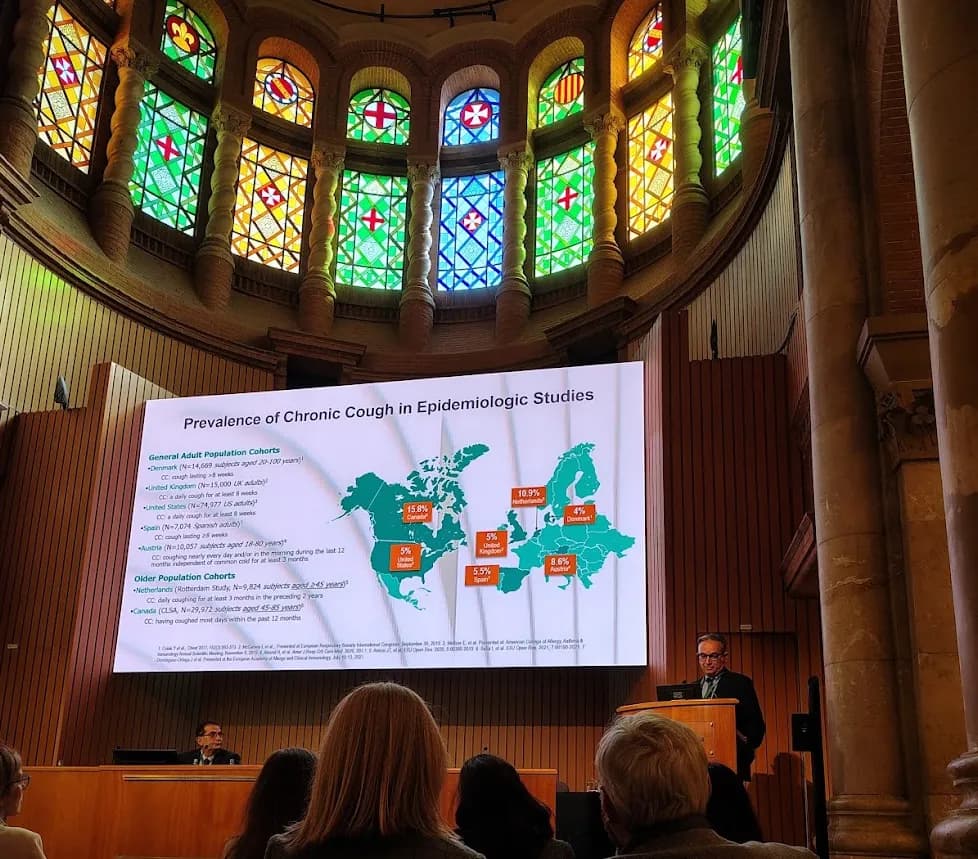
The cough measurement conversation has moved on. Multiple monitoring technologies were in the room and the questions have shifted from "can we count coughs?" to harder ones: how do we handle day-to-day variability, does cough intensity matter alongside frequency, and what level of measurement accuracy do trials actually need for a go/no-go decision? Several KOLs called for device companies, academics, and sponsors to collaborate on shared standards. I think that’s the right direction.
The placebo problem is real, and it's being taken seriously. Prof. Alyn Morice made a point worth sitting with: for many RCC trial patients, the study is the first time they've felt genuinely listened to and cared for. That alone may explain part of the large placebo response we keep seeing. Trial designs are evolving, placebo run-in periods are being incorporated into Phase 3 programs, but this remains one of the field's hardest problems. I have some hypotheses…
Access to treatment remains frustratingly uneven. Gefapixant has real-world evidence of benefit from Japan, yet most European countries have declined to fund it. At the same time, camlipixant's Phase 3 program is advancing with enrichment strategies designed to address the very issues that stalled earlier P2X3 programs.
Overall, the field is moving and the conversations are getting sharper. I feel optimistic about where cough science is headed.
What the paper found: This analysis is the first to quantify the financial impact of digital endpoints in clinical trials. Drawing on 164 industry trials containing 393 digital endpoints, they found that digital endpoints reduced phase III trial length by 4–5 months and enrollment by 12%, translating to a return on investment of 14–22x against a median implementation cost of $1 million. Phase II benefits were also significant, enabling earlier go/no-go decisions.
Why it matters: For anyone still asking whether digital endpoints are worth the investment, this paper puts hard numbers on the table. The ROI is transformative, particularly in phase III. The authors also make a point I think the field needs to hear: the stalemate between sponsors waiting for regulatory certainty and regulators waiting for high-quality submissions will only break when sponsors lead. The tools are mature, the regulatory pathway is open, and the financial case is clear.
Our team will be at ATS 2026. Stop by Booth 916 to see our technology in action and talk with us about continuous cough monitoring, clinical trial applications, or anything else on your mind.
We're also presenting two late-breaking posters:
These presentations feature the newest and potentially practice-changing data. We'll share more details closer to the conference. If you'd like to meet in person at ATS, drop me a note at peter@hyfe.com
Until next month,
Peter Small, MD
Chief Medical Officer, Hyfe
