53
Research Trials
20
Peer-reviewed publications
16
Clinical Conditions
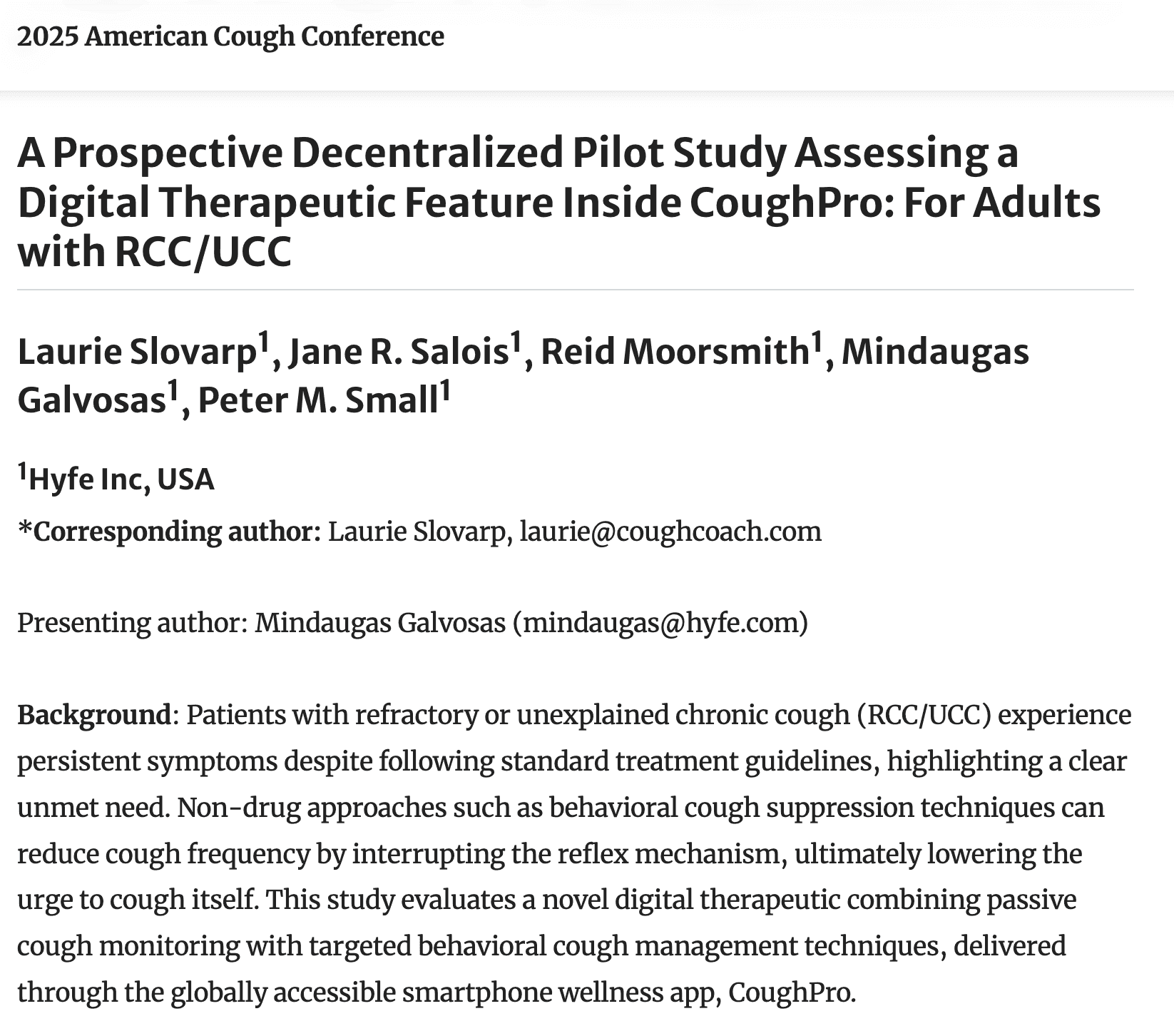
Hyfe pilot study tests a digital therapeutic combining passive cough monitoring with behavioral suppression techniques delivered through the CoughPro app.

This narrative review by Hyfe's R&D team makes the case that continuous cough monitoring (CCM), powered by acoustic AI, transforms cough from a subjective symptom into a quantifiable digital biomarker.

Independent ERS 2025 NeuroCOUGH trial uses the Hyfe Cough Tracker to test feasibility of studying azithromycin's effect on cough and oesophageal motility.

Rationale
Periods of intense coughing (termed bouts, epochs or bursts) are particularly problematic for some coughers and may not be reflected by simply counting the number of coughs per day. The most widely used definition of a bout is arbitrarily defined as 2 or more coughs separated by less than 2 seconds and is poorly correlated with patient reported outcomes. Continuous cough monitoring enables a more rigorous analysis of this phenomena. This study explored how varying the definition of bouts yield different impressions of cough severity.
Two weeks of continuous cough data from two chronic coughers were analyzed to explore how different definitions of cough bouts (inter-cough intervals and minimum number of successive coughs) impact the resulting cough pattern. Bout definitions were varied using inter-cough intervals of 2, 4, and 6 seconds, and minimum successive cough counts of 2 and 6. Daily cough counts, longest bout in seconds, number of bouts per day were examined for each inter-cough interval.
We observed that Participant 1 coughs far more than Participant 2 on a daily basis (Panel A) - mean coughs per day (1,420 vs 691 - dashed lines). One might conclude that coughing is a more serious problem for Participant 1. However, Participant 2 has longer cough bouts (2 successive coughs per bout) than Participant 1 (Panel B). Participants 1 and 2 have inconsistent ranking when bouts are defined by minimum number of coughs (2 or 6 successive coughs per bout) - Panel C. Longer inter-cough intervals inflate the number of bouts across definitions.
There is a pressing need to understand the impact of cough bouts on a patient’s experience. Continuous cough monitoring provides a new opportunity to rigorously study cough bouts. Using cough monitoring data, we demonstrated that different definitions give profoundly different impressions of cough severity in these two iconic coughers. The prevalence of this observation in a population of coughers needs to be explored. If this is common, additional studies are needed to determine which definitions best correlate with what patients find most troubling about their cough (such as incontinence).
Take-home points: