Get expert insights into cough science, monitoring and research
Exacerbations are a major cause of morbidity, hospitalization, and mortality in Chronic Obstructive Pulmonary Disease (COPD). Reducing the frequency of exacerbations is therefore a key goal of therapeutic interventions, with exacerbations anchoring the endpoint hierarchy in COPD clinical trials1.
However, exacerbations can be mild and not immediately obsious to research participants and they are irregular events and generally identified only once symptoms have worsened enough for patients to report them or seek medical attention2,3. There can be a delay of several days from onset of an exacerbation to recognition and action3, and clinic visits provide only intermittent snapshots of the disease status. This means that clinical trials capture whether an exacerbation occurred or not, but not the trajectory of symptoms leading up to, during, and following the event.
Cough is a cardinal symptom of COPD and is closely associated with disease progression and exacerbation risk4,5. While COPD is often thought of as a disease of dyspnea, cough is prominent in many patients: frequent productive cough has been reported in 38% to 69% of people with COPD depending on the population, including 68% of symptomatic participants without a recent exacerbation in the KRONOS trial.⁵ Increased cough with sputum production is considered an early warning sign of acute exacerbation and is also associated with accelerated lung function decline6,7. An odds ratio (OR) of 2.39 for high exacerbation risk has been reported among individuals with COPD and chronic cough with sputum production5.
Despite its clinical relevance, cough remains under-measured in COPD clinical trials. Cough is typically assessed using patient-reported questionnaires, such as the St George's Respiratory Questionnaire (SGRQ) and COPD Assessment Test (CAT)8. These multi-question tools assess the overall impact of the disease on patients,
including specific questions about cough. Emerging evidence suggests that the correlation between objective cough counts and the cough specific question is moderate at best (and more accurate assessments of cough than the overall measures). Although these tools are useful and validated for assessing the patient’s experience, they rely on recall and individual perception and therefore limit their ability to capture day-to-day and week-to-week trends that occur between clinical assessments.
Thus, objective continuous cough measurement could address this gap. Rather than relying solely on periodic assessments of perceived symptom burden, incorporating cough quantification can provide a complementary, longitudinal measure to strengthen patient monitoring, disease characterization, and interpretation of treatment response9.
Advances in sensor technology and AI now enable objective, continuous cough monitoring in real‑world settings10. Wearable and smartphone‑based systems can unobtrusively detect and timestamp cough events around the clock, at home, without requiring any additional action from the patient. Systems such as the Hyfe CoughMonitor Suite implement edge computing with detection models that run on-device for enhanced privacy protection, enabling continuous monitoring without the need for any specialized infrastructure11.
These devices make it feasible to study objective cough data at scale. By continuously tracking cough over days to weeks, changes in cough burden, variability, and daily and diurnal patterns can be characterized, offering key clinical insights. The feasibility of this has been demonstrated at scale: in a nine-week phase 2b antitussive trial, the Hyfe watch monitored more than 520,000 hours and captured nearly 11 million coughs, with adherence of 94.6%.¹⁹
For clinical trials, continuous cough monitoring can therefore provide a complementary, always-on digital measure alongside established endpoints such as exacerbation rate and lung function. This technology has already been deployed in more than 55 studies worldwide, supporting its use as investigational digital endpoints and exploratory biomarkers9.
There is growing evidence that objective cough monitoring can capture clinically relevant changes in cough patterns before an exacerbation, during recovery, and in response to treatment.
In a prospective longitudinal study of COPD patients, cough-based alerts preceded 45% of exacerbations by a mean of 3.4 days, with approximately one false alert per 100 monitoring days12. Earlier work, similarly, has shown that cough frequency decreases during recovery from an exacerbation13, suggesting that changes in cough frequency can reflect health status.
Objective monitoring has also been used to shed light on factors contributing to cough in COPD. Sumner et al. used ambulatory cough monitoring to examine the relationship between cough and sputum production, smoking, pulmonary function, and airway inflammation. They found that these factors were important determinants of cough, rather than cough reflex sensitivity alone14.
The potential value of objective cough measurement has also been explored in interventional studies. In a phase 2a randomized COPD trial for navafenterol (NCT03645434), 24-hour objective cough counts were included as an exploratory outcome. Cough frequency over time appeared to be more sensitive to changes in cough than a subjective visual analogue scale, although a COPD-specific minimal clinically important difference (MCID) has not yet been established 15. In another randomized trial (ISRCTN44651852) evaluating oscillatory positive expiratory pressure (OPEP) devices for COPD patients with regular sputum production, reductions in objective cough counts correlated with improvements in subjective cough measures and quality of life. A substudy combining cough monitoring with sleep actigraphy provided additional insight into night-time cough patterns and their relationship with sleep disruption16.
Together, these studies demonstrate that objective cough measurement is feasible and clinically informative, providing a basis to leverage continuous cough monitoring in COPD trials and strengthen endpoint strategies.
The potential of this approach is now being tested prospectively in COPD. In Hyfe’s ongoing multicenter observational study (NCT07212439) in Navarra, Spain, patients are being passively monitored 24/7 to characterize cough variability and assess its potential in exacerbation detection17. This provides an opportunity to understand how objective cough patterns change around clinically confirmed exacerbations.
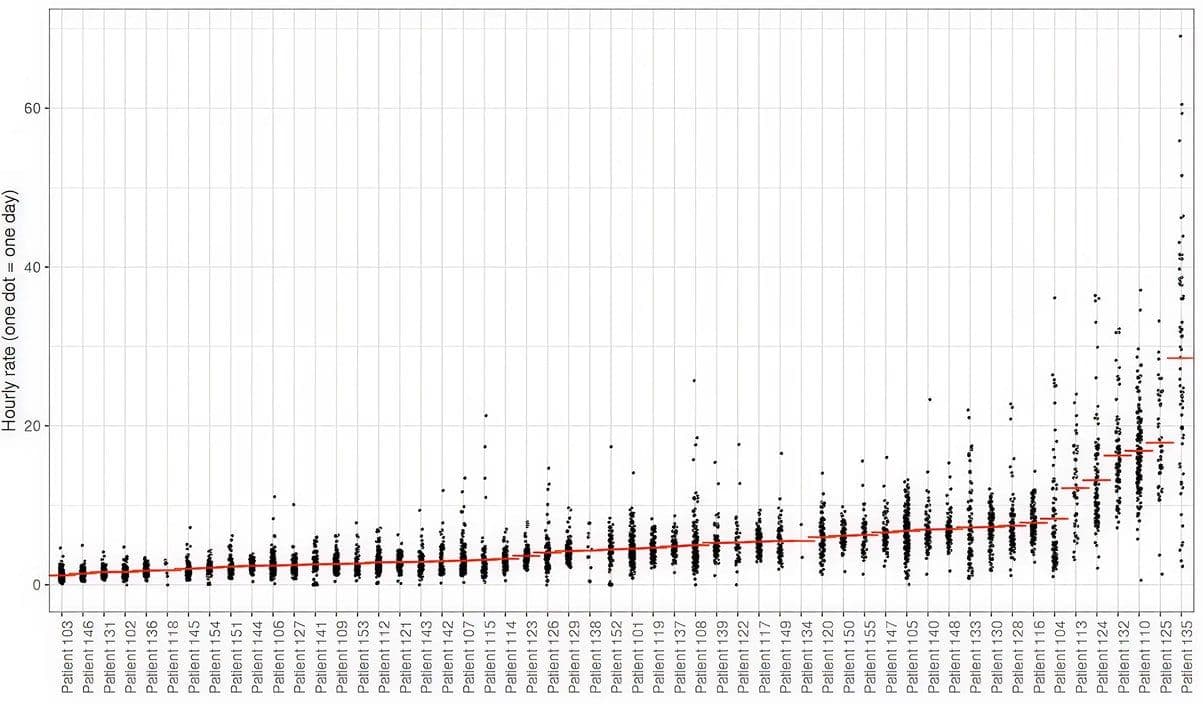
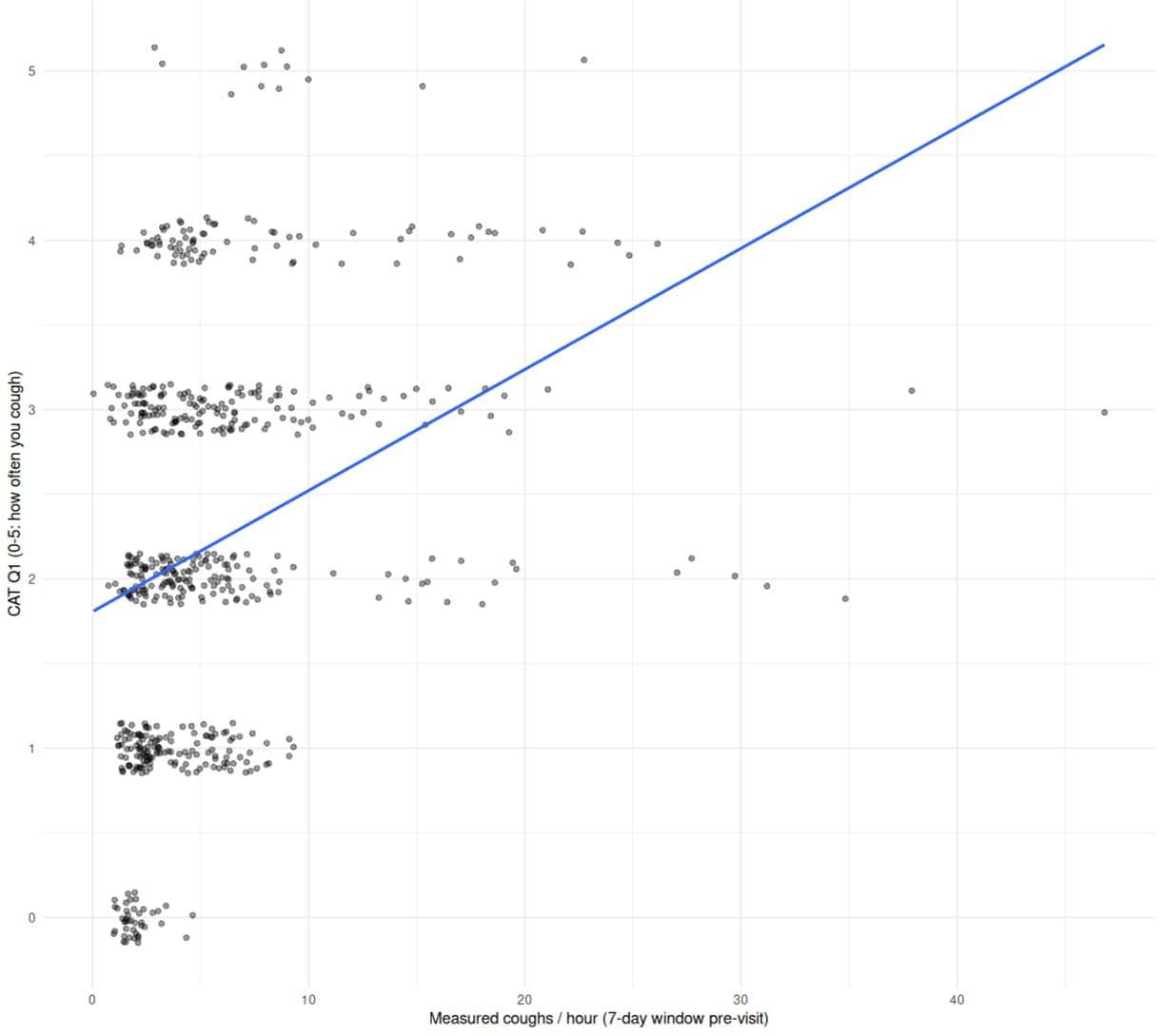
Interim analysis from 54 participants (as of July 2026), representing ~135,000 patient-hours of monitoring, >750,000 cough events, and 22 exacerbations, shows substantial variability in cough.¹⁸ CAT scores and subjective perception correlated only weakly with actual cough rates. Interestingly, mean hourly cough rates increased in the 10 days preceding exacerbations, with cough counts up to 33% higher in the three days before diagnosis. When an individualized seven-day baseline model was applied, objective cough monitoring achieved an AUC of 0.62 for predicting an exacerbation in the following seven days, positioning continuous cough monitoring as a promising digital biomarker.¹⁸
However, the variability both between and within patients (Figure 1) reinforces that cough should not be viewed as a universal or stand-alone predictor. Rather, it is an important signal that can be used alongside activity, breathlessness, and sleep to add an objective, longitudinal layer to existing measures.
Figure 1: Interim results from continuous cough monitoring for early detection of COPD exacerbations using Hyfe CoughMonitor wearable.
Per-patient CAT score vs measured coughs
These findings are highly relevant to current COPD drug development programs, which focus on reducing exacerbations and use the frequent-exacerbator phenotype to enrich trial enrollment. Passive monitoring also fits well with decentralized and lower-burden trial designs, and adherence supports that. In the first 11 participants, the watch captured data for 98.5% of expected monitoring hours,¹⁷ and the full cohort showed similarly high adherence to both continuous monitoring and weekly CAT questionnaires.¹⁸ This echoes the 94.6% adherence in the nine-week phase 2b trial described earlier. Collecting longitudinal data in everyday settings is operationally practical and scalable, and near-complete capture means little missing data on the endpoint.
Objective cough monitoring is not a replacement for exacerbation rate or FEV₁. Its value lies in adding a sensitive, passive, and longitudinal measure alongside established endpoints. Cough is now a measurable signal, which is relatively underused in COPD trials, and the evidence supporting its measurement is real, published, and growing.
For sponsors, incorporating this additional layer of continuous data could provide a more detailed view of changes around exacerbations and treatment response, strengthening the overall endpoint strategy. Ultimately, such approaches will
increase the likelihood that drugs not only prevent exacerbations but also improve a major debilitating symptom, thus improving quality of life.
References: