Get expert insights into cough science, monitoring and research
A wrist-worn microphone doesn't know who coughed. So a question comes up naturally is: if a cough monitor is listening passively, won't it pick up coughs from other people? And if it does, does that contaminate patients' cough count and weaken the endpoint?
Two studies address this, both designed to make contamination as likely as possible to occur, and both reviewed by Japan's PMDA when it accepted the Hyfe CoughMonitor Suite as the primary-endpoint device for a Phase 3 trial. If bystander contamination were going to be a real problem for a cough endpoint, these are the conditions that would surface it.
The short answer: other people's coughs are detectable, rare, small relative to a patient's own signal, and structurally incapable of manufacturing a treatment effect.
Here is the evidence behind each part of that sentence.
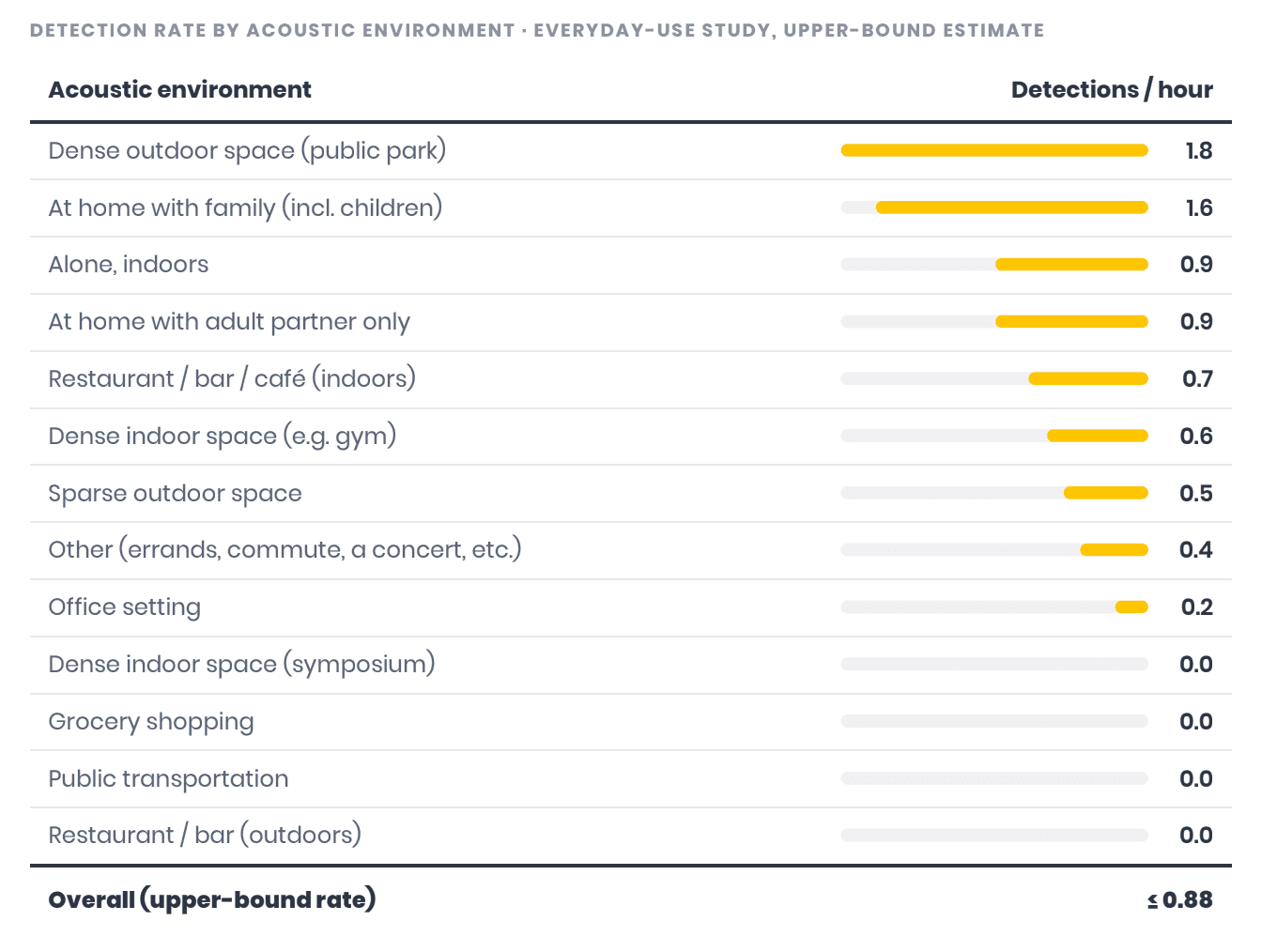
Ten healthy volunteers wore the device through a normal day, logging their surroundings, while deliberately not coughing themselves. Since none of these could be true user coughs, anything the device detected was either a bystander cough or a false positive, so the result is a ceiling on contamination, not an estimate of it. Across 854 person-hours, the device detected 755 events, 0.88 an hour at most. Most of that came from a handful of noisy settings. In an office, on public transport, or at an outdoor table, the rate was close to zero. It rose in dense social settings and at home with family.
Detection rate by acoustic environment, everyday-use study (854 person-hours, 10 non-coughing volunteers, upper-bound estimate). Overall rate of 0.88 detections per hour or lower, with most environments at or near zero.
Living with someone who coughs is the harder test. It's also the design PMDA specifically requested, because it gives a known denominator: the exact number of coughs available to contaminate the wearer's count.
Six participants across three households wore the monitor alongside a coughing partner who also wore one. The partner's device recorded 4,490 coughs over the study. A cough detected on both devices within 500 milliseconds was counted as contamination.
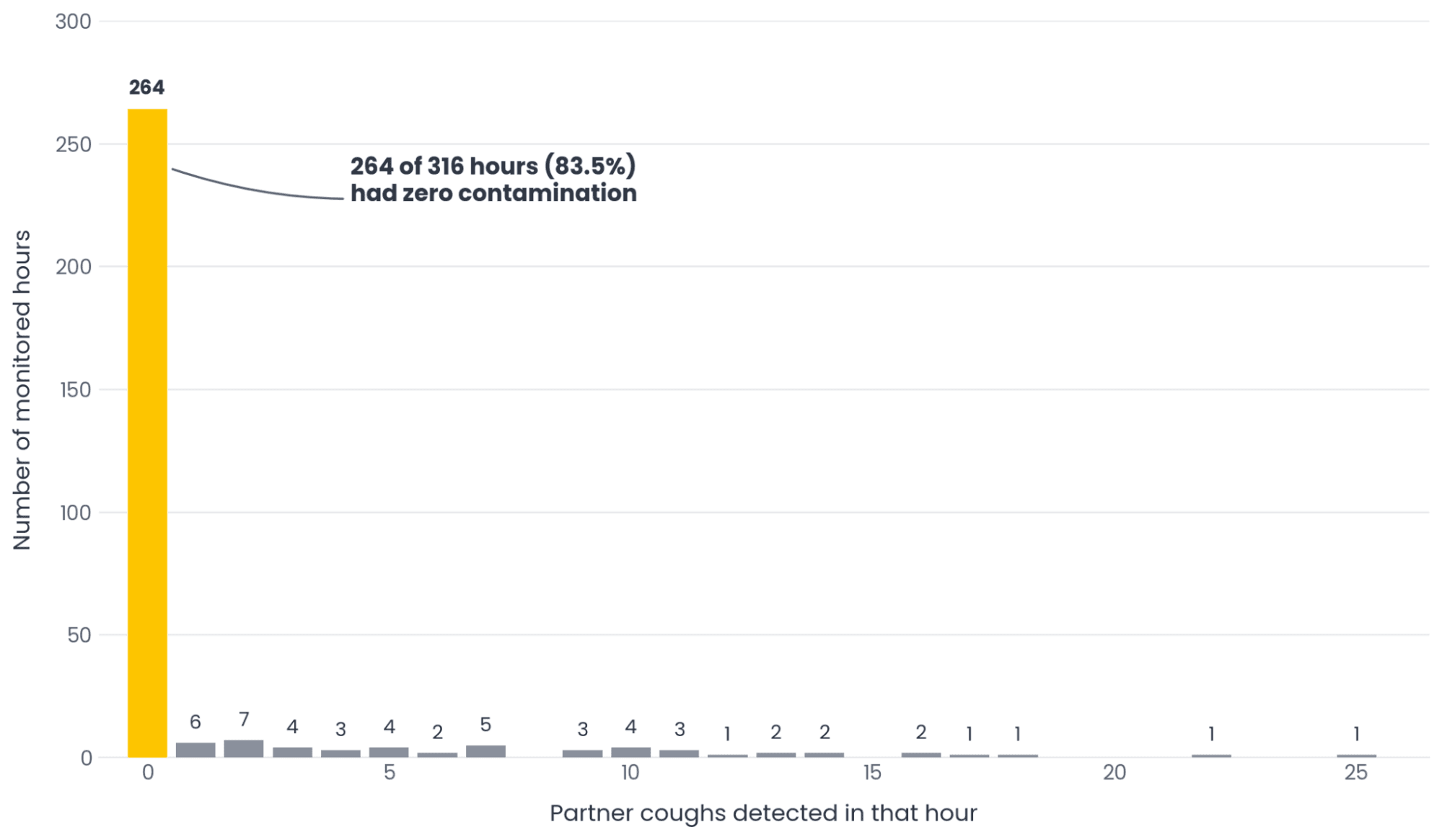
Across 316 person-hours, the wearer's device picked up 391 of those 4,490 coughs: 8.7%, or 1.24 contaminant coughs per hour. Of the 316 hours monitored, 264 (83.5%) had zero contaminant coughs. 32 hours (10.1%) had five or more.
Distribution of monitored hours by number of partner coughs detected (316 person-hours, 3 households). 264 of 316 hours (83.5%) contained zero contamination.
Trial arm doesn't change this. A drug-arm patient and a placebo-arm patient are equally exposed to bystander coughs, so contamination affects both arms by the same amount. It cannot manufacture a treatment effect between them.
Scale also limits its impact. Hyfe's continuous chronic-cough dataset shows an average of 326 coughs a day per patient, about 14 an hour. A contaminant cough or two an hour is under a tenth of that.
The low rate traces to the device's detection range. Detection is tuned to the wearer's own mouth, within about 1m, and falls to roughly half that sensitivity by 2m, about the distance to another person in conversation. A bystander's cough has to be close and loud to register.
In everyday use, contamination is at or below about one detection an hour, even when generously overcounted. Living with a cougher, it stays in that same range and is absent in most hours. Set against a patient who coughs hundreds of times a day, and balanced across trial arms, it does not bias a cough endpoint.
On this evidence, Japan's PMDA accepted the CoughMonitor as the primary-endpoint device for a Phase 3 trial.