64
Research Trials
29
Peer-reviewed publications
17
Clinical Conditions
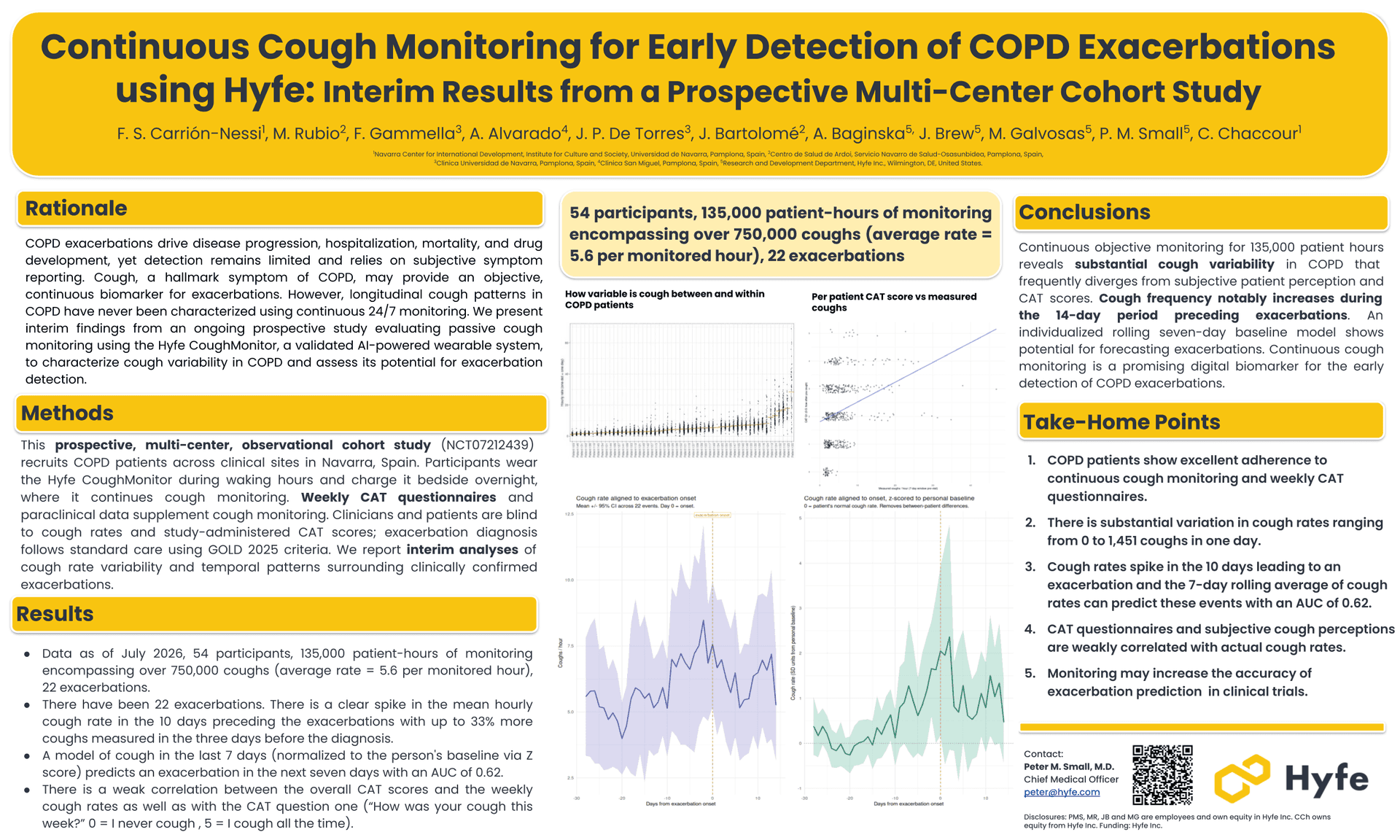
Updated interim data from 54 COPD patients and 135,000 monitored hours, showing cough rates rise in the days before exacerbations and correlate only weakly with CAT scores.
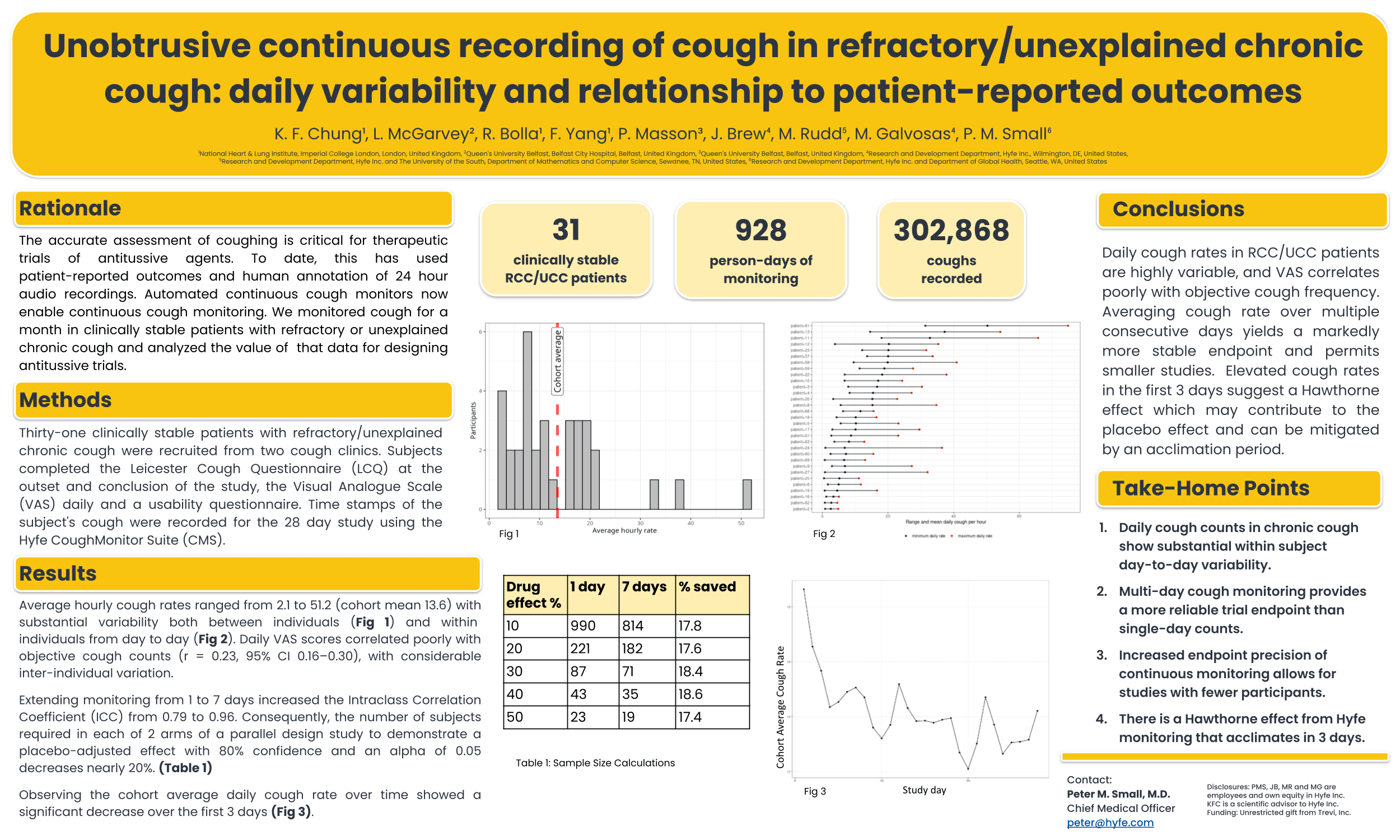
A month of continuous monitoring in stable chronic cough shows that multi-day averaging makes cough frequency a more reliable trial endpoint, allowing smaller studies, and reveals a short-lived Hawthorne effect.
Mixed-methods study in Kampala assessing 48-hour cough frequency monitoring with the Hyfe Research app for TB screening and triage, alongside staff-reported implementation barriers.
1 October 2024 · ERS Congress 2024

Real-time continuous cough monitoring using wearable technology is a novel technique of quantifying disease severity in patients with chronic cough. Little is known about how daily objective cough count measured by such devices correlates with subjective assessment of symptoms in cough patients.
Patients with chronic cough were monitored the Hyfe CoughMonitor for 30 consecutive days and concomitantly recorded daily cough severity scores using the Cough Visual Analogue Scale (VAS). Objective cough count data collected was recorded and correlated with daily VAS scores.
12 Patients recorded a median of 93 coughs per day (range 3-637) with a mean (SD) cough VAS score of 43mm (24mm). There was no significant association between daily cough count and daily cough VAS score in any of the patients. Scatter plots demonstrating these relationships can be visualised in Figure 1 and the Pearson correlation coefficients can be seen in Table 1.
There is no association between daily objective cough counts and daily cough VAS scores, more work is required to find the optimal endpoint for responses to treatment for chronic cough.
Bring objective cough data to your study. Schedule a meeting →