Find all editions of Cough Science News below and get access to the latest cough science developments, publications, and interviews with cough experts.
5 September 2026
Hello,
The September edition of Cough Science News is always an exciting one, following several major conferences and leading into the last quarter of the year, there’s always a lot of interesting things to report. This one is no different.
I just came back from the IPF Summit and my main takeaway was this: there's a striking disconnect between the patient perspective identifying cough as the most troubling symptom and its virtual absence as a serious consideration in drug development for the disease.
That gap is on my mind going into our next Cough Science Forum, where the most recent preliminary cough data in IPF will be presented alongside a broader question about how we measure cough in trials at all (details below). After that comes the monthly research.
But first:
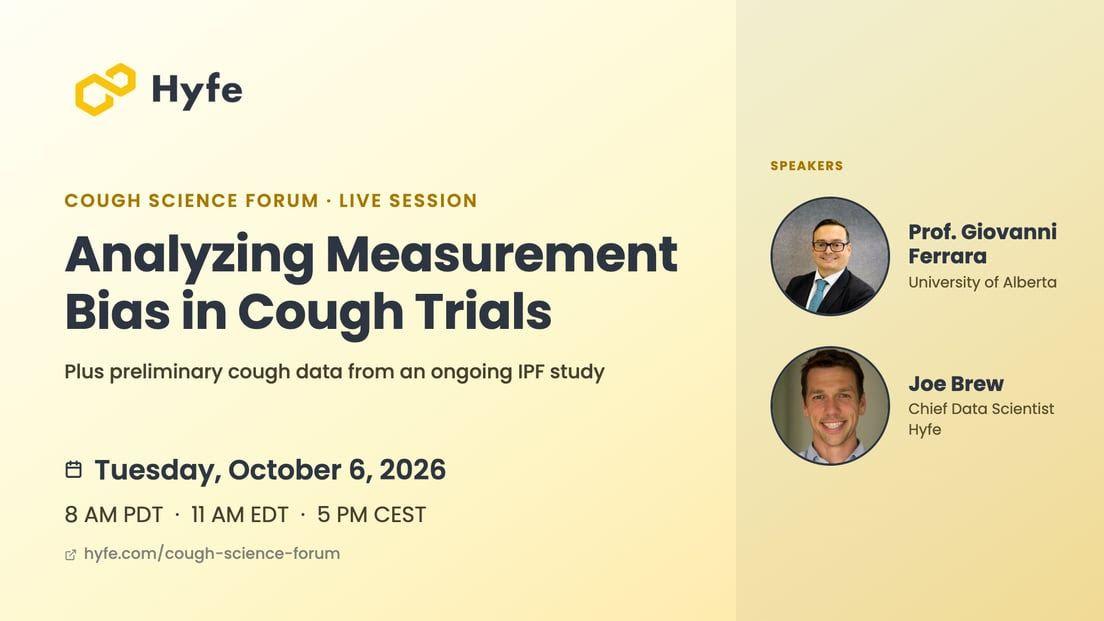
Join us tomorrow for the Cough Science Forum
I haven't been this excited about an observation since we first saw how much cough varies from one day to the next. In fact, anyone who saw a preview of this data was feeling the same.
As someone with chronic cough myself, I know that when I think about my cough, I cough more, and when I work hard not to, I cough less. That simple fact may matter a great deal for clinical trials. If the act of monitoring changes the cough we are trying to measure, then some of what we think we know about cough deserves a second look.
That is the question at our next Cough Science Forum. Joe Brew, our Chief Data Scientist, will walk through what we have been seeing and the questions it raises. I can't emphasize enough how important I think this is, particularly as the field moves beyond refractory chronic cough, where cough is the disease, into the much bigger world of cough as a symptom: IPF, bronchiectasis, asthma, COPD. That's why I'm especially glad Professor Giovanni Ferrara of the University of Alberta will open the session with a first look at continuously measured cough in IPF from his ongoing study.
Come join the discussion, and bring your skepticism.
What the editorial argues
Writing after the ERS Cough Conference, Morice sums up his case in one line: "Single-day average cough counting is the wrong endpoint to use in cough trials." He points to within-patient day-to-day variability on the order of a third, plus a Hawthorne effect inherent in single-day recordings, and suggests both have contributed to the apparent failures of gefapixant, orvepitant and lesogaberan to win licensing approval. In place of coughs per hour, he proposes measuring cough bouts and time spent not coughing.
Why it matters
This is an argument rather than a proof, and Morice presents it as his own suggestion, but it echoes the variability we and others have published about using continuous data. I'd expect sponsors to be asked about single-day endpoints before they lock in their next protocol.
What the review found
This narrative review covers the mechanisms, assessment and treatment of cough across interstitial lung disease. It puts chronic cough at roughly 72% across ILD subtypes and notes that in IPF it is associated with disease progression, while antifibrotics have shown limited and inconsistent effects on it. Low-dose morphine and extended-release nalbuphine in IPF, along with speech and language therapy, show the most promise. The authors also note that day-to-day variability in refractory cough can reach 33%, and that trials may need continuous recording across several days to limit its impact.
Why it matters
It sits well alongside what I heard at the IPF Summit: a common, burdensome symptom with few effective treatments and no standard way to measure it. The point about multi-day recording echoes the variability argument above, and work from our team on continuous monitoring is among the references.
What the study found
Using passive nighttime audio from users of a mobile sleep app, with AI cough detection, the authors analyzed 32 cities in 12 countries over about 500 days. Each 10 µg/m3 rise in PM2.5 was associated with a 2.4% rise in nocturnal cough frequency. Cough also rose during the January 2025 Los Angeles wildfire, which the authors treat as supporting rather than causal evidence. Two authors work for the app company.
Why it matters
The effect is small, and the data come from app users with outdoor PM2.5 standing in for exposure, so I wouldn't over-read it. It does remind us that cough responds to the environment, which is one more source of day-to-day variability in outpatient studies.
On hyfe.com, we work through the questions that come up repeatedly in conversations with sponsors and investigators. This month:
Quantifying other people's coughs in continuous monitoring
Other people's coughs are detectable, rare, small relative to a patient's own signal, and structurally incapable of manufacturing a treatment effect. Take a look at the evidence behind each part of that sentence.
Thank you!
Until next month,
Peter Small, MD
Chief Medical Officer, Hyfe
